
Short answer: In 2026, most published bulk SMS rates in India fall between roughly ₹0.10 and ₹0.22 per SMS before tax. Promotional SMS usually sits at the lower end and transactional/OTP at the higher end (TechTo Networks, LeadNXT). On top of that, operators charge a DLT scrubbing fee of ₹0.025 per SMS (Exotel). You also pay a one-time DLT entity registration of about ₹5,900 (₹5,000 + GST) on Jio, Airtel or Vi (Infobip), and 18% GST on the whole bill (GST Council).
So when a vendor quotes “₹0.12 per SMS”, your real cost per delivered message can be noticeably higher. This guide shows where the gap comes from and how to shrink it.
Why every bulk SMS service in India runs on DLT
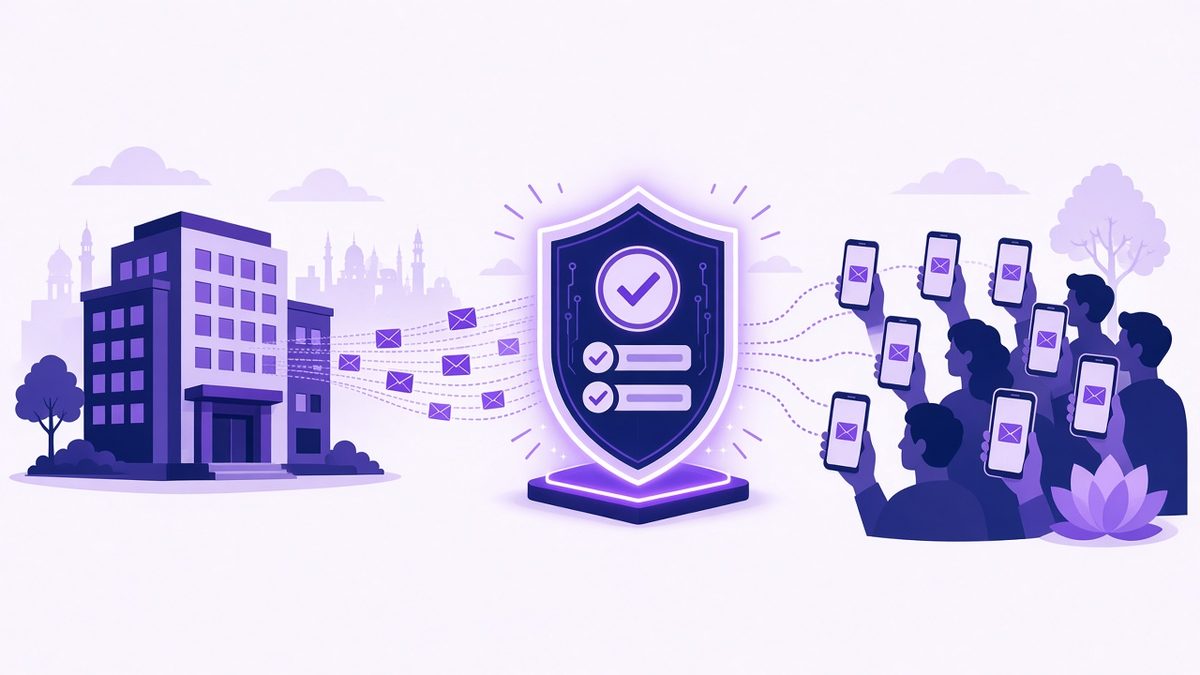
Since 2020, every commercial SMS in India has to pass through an operator’s DLT (Distributed Ledger Technology) platform. This is set up under TRAI’s Telecom Commercial Communications Customer Preference Regulations (TCCCPR), 2018. Before you can send anything, your business, your sender IDs (headers) and your message templates all have to be registered. The operator checks (“scrubs”) each message against those records before it is delivered.
The rules got stricter after 2024:
- URL whitelisting (from 1 October 2024): SMS containing URLs, APKs or OTT links that are not whitelisted are blocked (TRAI Press Release 67/2024).
- Header suffixes (2025): Following the February 2025 TCCCPR amendment, operators rolled out -P, -S, -T and -G suffixes on SMS headers. These mark messages as promotional, service, transactional or government (Business Standard).
- Pre-tagged template variables (November 2025): Every variable in a template, such as
#url#, must be tagged by purpose. Messages that use non-compliant templates are rejected once the compliance window ends (TRAI Press Release 133/2025). - Third Amendment (18 September 2026): This adds AI/ML-based spam detection, faster complaint-based action against senders, suspension of misused headers and templates within six hours, and a 7-day limit on messaging people who only made an enquiry (PIB, 18 Sep 2026).
These rules matter for cost. A message that fails scrubbing is never delivered, and a header that gets suspended stops your campaign completely. Compliance is part of your cost per reached customer.
What decides your bulk SMS price in India

Two businesses can send the same number of messages and pay very different bills. These are the main factors.
1. Message category: transactional vs promotional SMS cost
- Promotional SMS (offers, launches, lead generation) is usually the cheapest per message. However, it cannot reach numbers registered on DND for that category, and providers commonly state time-of-day restrictions on it (LeadNXT).
- Transactional and service SMS (order updates, alerts, reminders) cost a little more but can be sent to DND numbers, provided they are genuinely transactional or service messages.
- OTP SMS usually costs the most because it travels on priority routes.
2. Monthly volume
Almost every provider uses volume slabs. One published example falls from ₹0.40 per SMS at 5,000 messages to ₹0.12 at 1 lakh (MetaReach). Small senders pay much more per message than large ones.
3. Message length and language
A single English (GSM) SMS can carry up to 160 characters. Once it goes over that limit, each part holds 153 characters. Unicode messages, which you need for Hindi, Telugu, Tamil and other Indian scripts, hold 70 characters in a single SMS and 67 per part after that, and each part is billed as a separate SMS (TechTo Networks). The same reminder in Telugu can therefore cost two or three times as much as in English.
4. DLT pass-through and billing basis
Some providers include the ₹0.025 DLT fee in their per-SMS rate, and others add it as a separate line. Also check whether you are billed on submitted or delivered messages. The operator’s DLT charge applies to every submission (Exotel), so invalid numbers on your list still cost money (SMPP Center).
5. Platform fees and minimum commitments
Some vendors have no minimum. Others ask for a monthly commitment or keep custom pricing for enterprise plans only (LeadNXT).
Bulk SMS price comparison table (India, 2026)
Published market ranges, before GST. Your quote will depend on volume, route and provider.
| Cost component | Typical published range | Who charges it | Notes |
|---|---|---|---|
| Promotional SMS | ₹0.10–₹0.18 per SMS | SMS provider | Not delivered to DND-opted numbers (TechTo) |
| Transactional / service SMS | ₹0.12–₹0.22 per SMS | SMS provider | Can reach DND numbers if correctly classified (TechTo) |
| OTP SMS | ₹0.14–₹0.28 per SMS | SMS provider | Priority routing (TechTo) |
| Mid-volume blended rate | ₹0.07–₹0.17 per SMS | SMS provider | From a 10-provider comparison (LeadNXT) |
| DLT scrubbing fee | ₹0.025 per SMS submitted | Telecom operator | In force since 1 Sept 2020 (Exotel) |
| DLT entity registration | ₹5,900 incl. GST (Jio/Airtel/Vi); BSNL lower | Telecom operator | One-time on first portal (Infobip, Muzztech) |
| Header & template registration | Generally free on major portals | Telecom operator | Some providers charge a service fee (SMSGatewayHub) |
| GST | 18% | Govt (via invoice) | SAC 9984 telecom services (GST Council) |
One caution: cheap headline rates are sometimes for low-priority routes or exclude DLT. Ask every vendor for the price per delivered SMS, including DLT, before GST. That is the only figure you can compare fairly across vendors.
A worked example (illustrative)
Say you send 1,00,000 transactional SMS a month and your provider quotes ₹0.15 per SMS, which is within the published range above:
- SMS charge: 1,00,000 × ₹0.15 = ₹15,000
- DLT scrubbing: 1,00,000 × ₹0.025 = ₹2,500
- Subtotal: ₹17,500
- GST at 18%: ₹3,150
- Monthly total: ₹20,650, or about ₹0.21 per SMS, plus the one-time ₹5,900 DLT registration
If, as an assumption, only 95% of those messages reach a handset, your cost per reached customer goes up to about ₹0.22. Measure your own delivery rate on a pilot batch rather than relying on this number.
DLT registration cost and steps
What it costs
| Operator portal | Principal Entity fee | Source |
|---|---|---|
| Jio TrueConnect | ₹5,900 (₹5,000 + 18% GST) | SMSGatewayHub, Muzztech |
| Airtel DLT | ₹5,900 (₹5,000 + 18% GST) | SMSGatewayHub |
| Vi (VILPower) | ₹5,900 incl. taxes | Arihant Global (PDF) |
| BSNL | Lower; published figures vary from about ₹3,450 to ₹3,540 incl. taxes | SMSGatewayHub, Arihant Global |
You normally pay only once, on the first portal. Your entity is then shared across the DLT network, and registering on other operators’ portals is free (Infobip). Renewal terms are reported differently by different sources: some describe the fee as one-time, while others report annual renewal on certain portals. Check the current terms on your operator’s portal before you budget.
Step-by-step DLT registration
- Register as a Principal Entity (enterprise). Pick one portal, such as Jio TrueConnect, Airtel DLT or VILPower. Enter your business PAN and verify your mobile number and email with OTPs.
- Upload KYC documents. These usually include your PAN, a business proof such as GST or incorporation certificate, and an authorisation letter.
- Pay the registration fee and submit. You get a temporary ID first and your Entity ID once the documents are verified (Arihant Global).
- Link your telemarketer. Add your SMS provider’s Telemarketer ID so they are allowed to deliver for you.
- Register headers (sender IDs). Use a 6-character alphabetic header for transactional and service messages. Promotional headers follow the operator’s format. Category suffixes (-P/-S/-T/-G) are added by operators.
- Register content templates. Pre-tag every variable, for example
#url#and#number#(TRAI PR 133/2025). - Whitelist your URLs, APKs and callback numbers before you send any message that contains them (TRAI PR 67/2024).
- Register consent templates if you plan to send promotions to customers who have given explicit consent.
Entity approval generally takes 24 to 72 hours (LeadNXT), though it varies by portal.
How GST works on bulk SMS
Telecommunication services fall under SAC 9984 and attract 18% GST (GST Council: Overview of Telecom Services). In practice, this means:
- The rate you are quoted is almost always before GST. Multiply it by 1.18 to get the real figure.
- GST applies to the whole invoice, including the SMS charge, any DLT pass-through and any platform fee. The ₹0.025 DLT charge becomes about ₹0.0295 with GST (SMPP Center).
- The DLT registration fee of ₹5,900 already includes GST (₹5,000 + ₹900).
- Intra-state vs inter-state: you will see CGST + SGST if your provider is in your state, and IGST if it is not. The total is 18% either way.
- Input tax credit: a GST-registered business can usually claim ITC on SMS used for business, provided it has a valid tax invoice. Confirm the treatment with your CA.
How to cut cost per reached customer
The cheapest SMS is the one you never send to the wrong person. These steps usually save more than haggling over paise.
Clean your list before every campaign
Remove invalid and duplicate numbers. DLT scrubbing is charged on submission, so a dead number costs as much as a real one (SMPP Center).
Classify correctly
Don’t send promotions on transactional templates. They will be caught, and since the 2026 amendment, misused headers can be suspended within six hours (PIB). Also don’t send real service messages on promotional routes, because those can’t reach DND numbers.
Keep messages within one SMS part
Edit your templates down to 160 GSM or 70 Unicode characters. For regional-language campaigns, it can be worth testing whether a short Unicode SMS or a voice message reaches more people per rupee.
Use channel fallback instead of SMS-only blasts
SMS is not always the cheapest option. On Meta’s India rate card effective 1 July 2026, a WhatsApp utility message costs ₹0.1150 before GST. That is less than a typical transactional SMS once you add DLT, while WhatsApp marketing messages cost several times more (xreach51: WhatsApp Business API pricing in India). A sensible sequence for most Indian businesses is:
- WhatsApp utility first for order updates, reminders and confirmations sent to opted-in users.
- SMS as fallback for anyone who isn’t on WhatsApp or whose message wasn’t delivered, and for OTPs where reaching every user matters most.
- AI voice for feature-phone users, low-literacy audiences and rural outreach, in the customer’s own language. Promotional voice calls must come from 140-series numbers (xreach51: TRAI 140 and 1600 series explained).
We have worked through this arithmetic in detail in SMS vs WhatsApp vs Voice: cost per reached customer.
Segment promotions
Send offers to people who engaged recently, not your full database. Fewer sends means lower SMS, DLT and GST costs, and fewer complaints, which now trigger action faster under the 2026 rules.
Track delivered and reached, not just sent
Ask for delivery reports, and judge every campaign by cost per delivered or responded customer.
Frequently asked questions
What is the bulk SMS price in India in 2026?
Published rates mostly range from about ₹0.10 to ₹0.22 per SMS before GST, depending on category and volume. OTP routes can go higher (TechTo Networks). Add ₹0.025 per SMS for DLT and 18% GST.
How much does DLT registration cost?
About ₹5,900 including GST on Jio, Airtel or Vi, and less on BSNL. You usually pay only on the first portal, and other portals are then free (Infobip). Renewal terms vary, so check your portal.
Is DLT registration mandatory for a bulk SMS service in India?
Yes. Every business sending commercial SMS must register its entity, headers and templates on DLT under TRAI’s TCCCPR framework. Unregistered traffic is not delivered.
What is the difference between transactional and promotional SMS cost?
Promotional SMS is usually a little cheaper but cannot reach DND-registered numbers for that category. Transactional and service SMS cost slightly more and can reach DND numbers, as long as the content is genuinely transactional or service-related.
Is GST charged on bulk SMS?
Yes, at 18%. Telecom services are classified under SAC 9984 (GST Council). Registered businesses can usually claim input tax credit.
Is WhatsApp cheaper than SMS in India?
For utility messages such as order updates and reminders, usually yes. For marketing messages, no: WhatsApp marketing costs several times more than an SMS. See our SMS vs WhatsApp vs voice cost comparison.
Send smarter with xreach51
xreach51, built by Smart Client IT Innovations in Hyderabad, brings DLT-registered SMS, WhatsApp Business API, AI voice and Telegram into one API and one dashboard. It supports 10+ Indian languages and keeps your data hosted in India. As a Meta Tech Provider, we help real estate, education, healthcare, financial services and public outreach teams set up fallback flows: WhatsApp first, SMS next, voice for everyone else. That way you pay to reach customers, not just to send to them.
Plans use prepaid credits that work across every channel. See the current packs on our pricing page (prices exclude 18% GST), or talk to us at xreach51.com to plan your next campaign.
Rates and rules change. Figures in this article come from the sources linked above as of October 2026. Confirm with your provider and operator portal before budgeting.